Pages

Web Browser for Mac: new version of Camino

Contrary to the Web Browser Firefox who is multi platforms, Camino was developed specifically for the environment Mac OS. It uses consequently clean technologies with Mac OS X like Finder or Spotlight for the users of Tiger. Relatively functional, this OpenSource Web Browser allows inter alia navigation by tabs, the blocking of the inopportune windows (popup), the addition of extensions (or plug-ins), the protection of the private life and the management of the remote loadings. Information had us somewhat escaped, but an update 1.5.1 was published a few weeks ago.

Among the innovations and changes which it announces:
  • The update of the engine of returned Gecko towards 1.8.1.6 grinding
  • Improvement of the blocking of the inopportune windows
  • Correction of the bug involving planting at the time of a right click on certain Web pages
  • Correction of the bug involving the...
posting of the orthographical correction in the scandalmonger
  • Correction of the bug preventing the posting of appeared alarms when Camino was hidden when this one becomes again visible
For the interested people, the file of installation of 18,4 MB could be repatriated since the dedicated page.

Installation of Ubuntu - How to start

When you start your computer, a simple program, called BIOS, is given the responsibility to initialize your computer, then to give the hand to a charger of starting which deals with charging an operating system, allowing carrying out more complex tasks. The BIOS includes some summary tools to detect the presence of peripherals like the keyboard and the mouse, to check the quantity of read-write memory available and to locate various media of storage, such hard disk, the reader of CD-ROM and the disk drive.

Once these basic operations finished, the BIOS seek a charger of starting. The BIOS has a parameter indicating on which media storage to seek a charger of starting initially. Chargers of starting can be installed on the majority of the media of storage: diskette, CD-ROM, hard disk, key USB… If your computer has of a diskette containing a charger of starting, of a CD-ROM containing a charger of starting and a hard disk...

containing a charger of starting, it is advisable to specify on which media can be found the charger of starting.

A parameter of the BIOS, the order of starting (or boot order), fulfills this function. The BIOS seeks a charger on the first media specified in the list and charges this one if there is one of them; if there is not; it seeks a charger on the second media of the list. The order of starting of the more recent computers should be CD-ROM, hard disk then diskette; it is not necessarily your case, or the case of the older computers. The latter generally try to initially detect the presence of a charger of starting on the diskette - - it is for that that you finally have an error message when you start your computer while having forgotten a diskette in the reader - -, then on the hard disk on the CD-ROM.

To start CD of installation or a live CD of Ubuntu, the first media on which the BIOS should seek a charger of starting must be the CD-ROM. If you are in one of these problematic cases, there are great chances that that is due to the fact that the BIOS of your computer is configured so that it initially seeks a charger of starting on another media that the reader of CD-ROM. It is then necessary to change the order of amorage in the BIOS - - a simple, but no commonplace operation explained below.
Procedure

To Start the computer Press the button of powering of your computer, and observe well what occurs. In the first second, Bios tests your processor and your read-write memory, and says to you how you can enter the configuration of Bios to modify it. Example:
To eter setup hit Del
Enter to Bios

To enter Bios, it is generally necessary to type a key (more rarely a series of keys). Generally, it is about “F2”, “F12” or “Enter”. This key is indicated to the screen in the first second starting.
Change the order of the boot

To find the section which makes it possible to change the boot order? The interface of Bios summarizes the various orders (to enter/leave a menu, to change the value of an entry, to leave Bios by safeguarding its adjustments, etc). You will have to arrive on a line or a menu resembling of near or by far that:

It is a question here of giving to the CD-Rom (or to the reader of DVD, according to your material) a priority of boot larger than that of the hard disk.
In our example, we change the value by CD-ROM, and we allot the 2nd position to the first hard disk.
To start on CD

Generally, when you leave the configuration of Bios, the computer starts again, and you can thus check that your modifications were indeed taken into account. If all occurs well, you should fall on the reception from CD.

How to Repair Demage Photo Using ACDSee?

If from any reason you or your children damaged your photos from vacation or some special events and you think you can't save them, well you can. You can do that very easily using ACDSee Photo Manager and his tool called Photo Repair Tool. ACDSee’s Photo Repair tool combines two very powerful tools to help repair problem photos. If you are beginner and you don't know how to use this tool just fallow our steps, but first we will tell few think about additional tools which you can use.

The Clone tool copies pixels from one area of a photo to another area, creating an identical image area. This tool is more effective for photos that have strong, simple textures or uniform colors, as it is more difficult to identify the copied pixels in the finished photo.

One more very useful tool is Healing Brush Tool. The Healing Brush tool also copies pixels from one area of a photo...

to another, but it analyzes the pixels in the source area before copying them. The Healing Brush Tool also works particularly well with photos that involve complicated textures like skin or fur.

Now to repair your damaged photo using ACDSee 8 fallow next steps:

  • First you need to be in Edit Mode, on the right side of window in Edit Panel select Photo Repair,
  • Now on the Photo Repair tab select one of the fallowing options:
  1. Heal - this option copies the pixels from the source area to the target area, and blends pixels into the surrounding image area.
  2. Clone - this option only copies the pixels from the source area to the target area.
  • Now what you need to do is drag the Nib Width and Feathering sliders. In table belowe you can find additional explanations about these two options:

Nib Width Sets the width of the brush in pixels.

Feathering Sets the amount to feather on the edge of the brush to prevent sharp transitions between the original and healed part of the photo.
  • After you finish with step 3 you can continue by pressing sight click on the image to set a source location. Pixels will be copied from this location and used in the target location.
  • Now click and Drag over the area that you want to cover. If you selected the Healing Brush, ACDSee analyzes and replaces the pixels only when you release the mouse button.
  • To finish with your repairing works do one of fallowing:
  1. Click option Done to apply all changes which you did made and to return to the Viewer mode or
  2. Click option Cancel to exit the tool and cancel all changes which you did made in previous steps.


How to optimize your computer performances with 2 hard drives?

If you have two hard drives in your PC, a good means of improving the output of the principal disc (i.e. that which contains the operating system) consists in moving the files “Temporary Internet Files”, “temp” and the file of exchange (also called “Swap”) on the hard drive where Windows 2000/XP is not installed.

Attention, for this method, one speaks well about two physical hard drives and not about two partitions resulting from the same disc. By definition, one will call first disc that which contains your operating system, the second hard drive containing for example your data.

Initially, we will move the file “Temporary Internet Files”, or rather will make so that the new way of this repertory is on the second disc. For that, create a file of the same name on the second hard drive (or you want) via the explorer or the work station.

Then, open the control panel, then choose...

“Internet Option”.

Go in the “General” tab, and then click on the button “Parameters”.

In the new window which has just appeared, click on “Moving the file…”

It any more but does not remain you to show the way of the repertory than you created before

The second phase will consist in moving the file “temp”.

Here also, it is necessary to create a file with the same name on the second hard drive.

Right click on the “Work station” then “Properties” and in the “Advanced” tab click on the button “Variables of environment”.

How to test your antivirus software?

You installed an antivirus, commercial or not, and you would like to know is he well configured, that he is active and that you are well protected. It is not recommended playing with fire and visiting dangerous websites to check can your antivirus detect any kind of virus. You would indeed be likely to expose your computer at the very important risk which can go until the compromising of your computer and the loss of data.

To test your antivirus in full safety, you can use the file of Eicar test. This file is detected as a virus by the antiviruses but it is not one, it does not contain any viral code. If the false virus is detected, it is that your antivirus is active and protects you.
  • To create this false virus, you need simply to create a file inside Windows. Click on the Start button, All Programs...

Accessories then on Notepad.
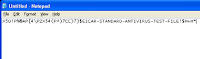
  • Then recopy the following character string in the Notepad:
X5O!P%@AP[4\PZX54(P^)7CC)7}$EICAR-STANDARD-ANTIVIRUS-TEST-FILE!$H+H*

  • Then save the file while clicking on File then Save as.
  • Unroll the “Save as type” list then select the option All files.
  • Add the name of file eicar.com in the zone File name. Choose the location where you want to save it (on Desktop) and then click on Save button.
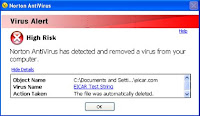
  • If your antivirus is correctly activated, it must then alert you instantaneously presence of the Eicar virus.
  • Then ask your antivirus to remove the file. In my case I had installed Norton Internet Security and file was recognize and removed automatically without any additional action from me.
If your antivirus does not see anything, than you have a problem. It could be because of two reasons: permanent protection is badly configured or there were some problems during antivirus installation. Then you have to read documentation of your software to correct this problem.

If the false virus is still not detected, you must then seriously think of changing anti-virus software.

How to convert DVD movie to videos?

More and more people want to convert DVD movies to other video formats nowadays, while there are so many kinds of video and audio formats being used widely, such as MPEG, AVI, DivX, XviD, MOV, QT(quick time), WMV, WMA, MP4, MP3 etc. The DVD conversion tools are bringing an easy way to help us backup DVD's, watch movies on portable player, download or upload video files via internet, and so on.

A general rule has been accepted in the converting market, that the more powerful functions the soft has, which means providing more output formats, the more appealing it becomes to consumers. So, our recommended product - ImTOO DVD Ripper Platinum, is the best one for you, especially DVD movie fans. It can rip and convert DVD movie and music files to such video and audio formats as MPEG , AVI, DivX, XviD, MOV...

WMV, MP4, MPEG-4, VOB, DAT, 3GP, 3G2, MP3, WMA, M4A, AAC, AC3, AU, OGG, MP2, etc. Being a powerful and easy-to-use DVD converter and ripper tool, the output quality and converting speed is perfect to comfort your needs. Don't hesitate any more, just follow what we said below, your favorite DVD movies will be easily carried out on your iPod, or PSP, or any other portable media players!

Now to convert DVD movie to videos using ImTOO DVD Ripper Platinum fallow next steps:
  • If you don't have ImTOO DVD Ripper Platinum you can buy him and install.
  • Run ImTOO DVD Ripper Platinum and Load your DVDs by clicking the "DVD" button on the interface or selecting the "Add DVD Folder" in the "File" menu.
  • Select the title or chapter you want to rip and specify the output formats by selecting an output profile in the "profile" combo-box at the bottom of the interface.
  • After specifying an output format for title or chapter, you can set the advanced setting options. The rip parameters panel on the right of the interface shows general standard parameters of the selected output format. By clicking certain setting, you may specify it, or just keep the default settings.
  • After setting everything OK, please start ripping by click the red button on the interface. All the checked chapters and titles in the list will be ripped.
Small Tips:
  • You can upload your PSP video ripped from DVD to your PSP player with the PSP video manager easily by clicking "PSP Video Manager" in the "Tools" menu.
  • Uploading the converted files to your Video iPod like what we said in the 2nd step of How to put and transfer movies to your Video iPod? If you don’t have iTunes, Please download it at: http://www.apple.com/itunes/download
  • ImTOO DVD Ripper Platinum also supports clip or segment conversion. You can convert any clip or segment by setting the start point and duration at will. The start point time format is hh:mm:ss, for example: 00:30:20. The duration time format is hh:mm:ss or s, for example: 00:00:40 or 40.
  • You can set various output formats for different files as you like.
  • You can set the preview window aspect by clicking "Preferences…" in the "Settings" menu.
  • You may adjust the offset of the DVD's subtitles in the "DVD(Global)" tab which's a part of the "Preferences…" option.
  • The operating language can be altered by clicking "Settings"⇒"Language" buttons.

How to Install the ACER ALN-320 Ethernet Fast Ethernet Adapter?

These instructions are provided as an example of how to install a PCI network adapter.

Note: if your motherboard has the VIA MVP3 Super7 chipset (e.g., the Epox EP-51MVPE-M or EP-58MVP3C-M) and is running Windows 98, We strongly recommend that you install the VIA IRQ Routing Miniport Driver before installing any network board. You should be adle to download it from the manufacture of your motherboard or, alternatively, from VIA. Determine what version of Windows your computer is running. Shut down/ turn-off your computer and unplug the power cord.

Remove the computer cover.
You "should" observe proper electrostatic precautions when handling the adapter.... Maintain contact between you body (bare skin) and the metal of the computer case or use a grounding strap while handling the adapter before it is plugged into the computer. Remove the ALN-320 from its plastic box, insert it into any available PCI bus slot, and fasten...

the top of the adapter to the case with an appropriate screw.

Plug-in your network cable.
Plug-in the computer power cord and turn it on. When Windows 95 or 98 boots up it should detect the adapter and display the following message:
"New hardware Found... AcerLAN ALN-320 10/100 Base-TX Fast Ethernet Adapter... Windows is installing the software for your new hardware"

You should then see the following window. Click OK if you do not want to fine- tune the setting. You can access and change this setting later from the Control Panel. I won't go into that here.

How to create empty file with specific size?

To create empty file with specific size fallow our next steps :
  • Open command prompt. To do that click Start-->Run... and type cmd,
  • Go to drive on which you want to create that empty file using command
  1. cd (with this command you will enter in directory),
  2. CD... (with this command you will exit from directory),
If you are in C:\Windows directory, command cd... will return you in C:\. Use command C: as much is necessary to return in root of partition. You can change partition buy typing capital of that partition (D, E, F, G, H etc.) example: if you are in partition C:\ and you want...

to go in D partition type D:
  • When you are in root of partition on which you want to create on empty file use next command: fsutil file createnew FileName Size
  • FileName is place where you can write a name of your new created file,
  • Size is place where you can write a size of you new created file. To calculate a size you can use next formula: 2 GB = 2 * 1024 = 2048 MB * 1024 = 2097152 KB * 1024 = 2147483648 bite
Example: If you want to create file and setup his size on 2GB you should type 2147483648
  • After this empty file will be created on selected partition with name and size which you did setup.
  • We recommend that you restart you computer.

How to improve sound on Video files?

  • You must use BSPlayer. Find plugin for WinAmp Enhancer017.exe (visit www.winamp.com and search plugins).
  • Install plugin in BSPlayer folder: C:\Program Files\BSPlayer\plugins\Winamp\,
  • Now, run Winamp and go to "Options > Preferences > Plug-ins" and change directory for "DSP/Effect plug-in directory" so he point to the place where you did install Enhancer,
  • Go to "Options > Preferences > Plug-ins > DSP/Effect", mark Enhancer and click on Configure,
  • Adjust "Volume 10, Harmonic Bass 5, Harmonic Bass Range 5, Drum Bass 5, Drum Bass Range 5, Dry Signal 10, Harmonic Treble 10, Harmonic Treble Range 10, Ambience off, Ambience Range 1,
  • Turn on "Power" and "Buster" (small lamp in top left corner you need to see green light if it is turn on),
  • Close all opened windows,
  • Run Winamp again and check setups,
  • Run BSPlayer and go to "Options > Preferences > Audio",
  • Turn on "Enable winamp DSP plugins",
  • Choose dsp_enh.dll,
  • If he don't exist setup Winamp plugin directory on C:\Program Files\BSPlayer\plugins\Winamp\,
  • Run any movie in BSPlayer and check is sound now strong than before,
  • If it is not try to setup sound setups while BSPlayer is open with movie,
  • After all restart your computer.
Note: These setups were checks in BSplayer 086.501 and they work great, if they work great also on your computer than you did improve sound on Video files

How to Enable UDMA66 Mode on Intel Chipsets?

If you have a computer with an Intel chipset that supports UDMA66, you will still find that UDMA66 mode is disabled by default on Windows 2000 computers. This tweak allows you to enable or disable it.
  • Click Start choose Run and type regedit to open your registry and find or create the key in step2:
  • HKEY_LOCAL_MACHINE\System\CurrentControlSet\Control\Class\{4D36E96A-E325-11CE-BFC1-08002BE10318}\0000]
  • Create a new DWORD value called "EnableUDMA66" and set it to "1" to enable UDMA66 or "0" to disable it.
  • Restart Windows for the change to take effect.
Note: Before you enable UDMA66 mode make sure that the device supports UDMA66 mode and use an 80-pin IDE cable with the proper pin cut.

How to delete file which can't be deleted from windows?

  • Click Start,
  • Choose Run and type cmd,
  • Again Choose Run and type taskmgr,
  • Go to Processes tab and find explorer.exe and turn him off (mark him and click on End Process),
  • Don't close Task Manager and go in command promt windows. Go to file which you can't delete and using commands cd for entry in file (cd program~1 or cd windows) and cd.. for exit from file (for example if we are in c:\windows\system32\ and we type cd.. you will exit in c:\windows\file)


How to create home page tabs in Web Browser?

1. Click on Start,

2. Go to Control Panel,

3. In Control Panel window double mouse click on Internet Options,

4. When Internet Options window in open in empty field write address for home page,

5. Click on OK,

6. Next time when you open Internet Explorer that page will open first.


How to remove picture which is showing before Welcome Screen?

To remove that picture which is showing before Welcome Screen in Windows XP do next:
  • Click on Star,
  • Click on Run...,
  • In Run window type regedit and press Enter,
  • In new window find next location: HKEY_USER\.DEFAULT\Control Panel\Desktop,
  • Find Wallpapers paragraph which will look something like this: ab Wallpapers REG_SZ C:\Dosument and Settings\
  • Click on that paragraph and delete all in Value Data
  • Click on OK and Restart your PC

After Restarting, screen after Welcome screen will be black like before. Value which you did delete you can save or you can change that picture on same way.

How to make Wireless Networking work?

No more tripping over messy cables or taking turns on the internet. Whether it's a PC in the bedroom or a notebook PC in your garden, wireless networking, or Wi-Fi, means you can use a computer where it suits you without a cable in sight.

Well that's the dream anyway. In practice Wi-Fi can be quite a different story. You might find that the signal runs out of steam in the next room, let alone reaching upstairs. Then again maybe it goes too far and lets your neighbours surf the web at your expense.

If that's not bad enough, perhaps your signal suddenly disconnects for no apparent reason, or maybe the latest piece of Wi-Fi kit refuses point-blank to communicate with anything else you've bought.

Sound familiar? When Wi-Fi problems arise, we're here to help. We've spoken to owners and trawled our forum to identify...

the most common Wi-Fi woes. We will explain why they happen and how they can be resolved. We'll help you make Wi-Fi wonderful again.
Compatibility (Wireless Networking)

Probably the biggest problem with Wi-Fi is compatibility. Sometimes two Wi-Fi products simply fail to communicate or do so at a much lower speed than expected. The reason is that there are several different types of wireless networking technology and they're not all compatible. Some manufacturers also tweak the standards or adopt new ones before they've been finalised to deliver superior performance, but by doing so often reduce their compatibility with products from other companies.

This is where Wi-Fi comes in. Wi-Fi isn't a wireless standard, but a certificate of compatibility. If two products have the Wi-Fi badge, they should work together with no problems. This system worked well when there was just one wireless standard but, as new technologies that support greater bandwidth have been developed, the Wi-Fi badge has become slightly tatty.

Today there are three popular wireless standards, known as 802.11a, 802.11b and 802.11g, although the letters don't stand for anything specific. To make things easier we will now refer to them as Wireless A, Wireless B and Wireless G.

Wireless B came first, offering a maximum data transfer rate of 11 megabits per second (Mbit/s). Wireless A followed, screeching away with a very nifty 54Mbit/s and fewer problems with interference, but it was expensive and, most significantly, incompatible with Wireless B equipment.

Next came Wireless G, sporting 54Mbit/s and backwards-compatibility with existing Wireless B equipment. In 2006, the next standard, 802.11n (Wireless N), with transfer rates of up to 540Mbit/s, should be finalised.

Today Wireless A is used by some business or high-end home users, but Wireless G has become by far the most widespread standard. The Wi-Fi badge indicates which standard is supported, with ticks in the appropriate box or boxes.

If two products have a Wi-Fi badge and ticks in the same boxes, they should work together without a problem. You don't need a Wi-Fi badge for compatibility, but it certainly offers extra assurance. The GHz rating you can see refers to the radio band used.

Wireless A operates in the 5GHz band, while the more common A and B version use the 2.4GHz band. This band is used by other household devices too, which we'll explain shortly.

If the manufacturer tweaks a current standard to add an extra feature or uses aspects of Wireless N for extra speed which have not been finalised, the resulting product can't carry the Wi-Fi badge.

If you're experiencing compatibility problems with existing kit, the best place to start is on the websites of the equipment manufacturers. Some offer firmware updates that solve problems, and most have technical support forums.

An excellent starting point is our own Readers to the Rescue forum.

You may also try one of the many online communities dedicated to solving wireless worries, such as wi-fiplanet, wi-fi-forum and wi-fitechnology.

Occasionally, changing a single setting can rectify the problem, but with so many manufacturers, and so many possible combinations of wireless devices, it can be tricky to isolate the loose thread between your equipment. You may simply need to swap the offending product for one that's guaranteed to work with your router. To be certain, either buy products which are Wi-Fi certified with ticks in the same boxes, or stick to products from the same manufacturer and range

How to convert FAT to NTFS file system?

To convert a FAT partition to NTFS, perform the following steps:

1. Click Start, click Programs, and then click Command Prompt.
2. In Windows XP, click Start, click Run, type cmd and then click OK.
3. At the command prompt, type CONVERT [driveletter]: /FS:NTFS.
4. Convert.exe will attempt to convert the partition to NTFS.

NOTE: Although the chance of corruption or data loss during the conversion from FAT to NTFS is minimal, it is best to perform a full backup of the data on the drive that it is to be converted prior to executing the convert command. It is also recommended to verify the integrity of the...

backup before proceeding, as well as to run RDISK and update the emergency repair disk (ERD)

How to create your website in 10 minutes with Microsoft Office Live?

As I am always on the lookout of the latest web services that facilitate the web, I found several websites which can help me to create my own website. There are many on Noovo, fun but limited, or more siteKreator already evolved. The problem is that in its free version, the proposed layouts are quite limited.

And then I found Microsoft Office Live. Three services are offered, currently in beta:

* Office Live Basics
* Office Live Essentials
* Office Live Premium

The first is free and, even at the end of the beta. The other two are free, but only during the beta. Nothing is mentioned about the future tariff policy.

Office Live Basics can create a website directly via a web interface. There are many layouts pre-established, and many customization features are offered. In addition, a domain name is understood in the service. It is also linked to a mall. For example, If you created website...

with name example.com you will get email address with same name email@example.com. An area of 500 MB is proposed to set up your site. To create the site just add pages and insert the content in Microsoft Word. The only limitation is that you must create the site with Internet Explorer.

Here is a Windows Office Live screenshot of the interface:

Simply select a layout, style (office automation, marketing, and building… with different colors). A download manager can insert any file type. It is even possible to add plug-ins that are currently in a limited number. For example, you could add module weather or a contact form generated automatically.

Frankly this tool is to make a great site "business card". After it does not involve mountains of creativity but for a small company or an association that seeks to present its work is the ideal.

The only obstacle to the use of the system is required to provide its Blue Card number for inclusion! A quirk especially when one wishes to register for Office Live Basics… which is free. Microsoft justifies this request by the desire to remove the inscriptions fanciful including spam. This is a real impediment to the inclusion and I myself hesitated. For the moment, no problems, but as usual I want you to know. Signup for WIndows Office Live from here.

How to filter pornographic content using Google SafeSearch Filtering?

If you have children, or maybe from some other reasons you can hide quite effectively pornographic content accessed through a simple search on Google. The search engine has long created several kinds of barriers to get rid of results which you do not want to show in your results.

From any browser, just go on Google. Google page is opened; click "Preferences" right of the search box:...

Now you have to find "SafeSearch Filtering", which offers three settings:

* Use strict filtering (Filter both explicit text and explicit images)
* se moderate filtering (Filter explicit images only - default behavior)
* Do not filter my search results.

The default revealing texts sexually explicit content, a small change will allow you to surf the heart lighter. It may be noted that even without protecting children, the solution is interesting to get rid of parasites results in the daily use.

How to make a partition in Linux post installation and how to mount it?

After logging into Linux what you have to do is you need to know if there is space available or not. If you are sure you got space follow the below mentioned steps:

df -h
Filesystem Size Used Avail Use% Mounted on
/dev/sda1 20G 15G 4.3G 78% /
none 942M 0 942M 0% /dev/shm
/dev/sda3 87G 7.2G 75G 9% /usr

fdisk -l
Disk /dev/sda: 120.0 GB, 120060444672 bytes
255 heads, 63 sectors/track, 14596 cylinders
Units = cylinders of 16065 * 512 = 8225280 bytes

Device Boot Start End Blocks Id System
/dev/sda1 * 1 2611 20972826 83 Linux
/dev/sda2 2612 3133 4192965 82 Linux swap
/dev/sda3 3134 14596 92076547+ 83 Linux

fdisk /dev/sda

The number of cylinders for this disk is set to 14596. There is nothing wrong with that, but this is larger than 1024, and...

could in certain setups cause problems with:

1. Software that runs at boot time (e.g., old versions of LILO)
2. Booting and partitioning software from other OS's (e.g., DOS FDISK, OS/2 FDISK)

Command (m for help): n
Command action
e extended
p primary partition (1-4)
  • Then using fdisk just make a new one using n,t option of fdisk
  • Then rebppt the system
  • Now let’s say you got the new driver which is /dev/sda8 which carries 10Gb
  • So after boot do mkfs /dev/hda8 and then manually mount /dev/hda8 /yourdirectoty or in etc fstab you have to mention the same for automount in every boot time.
We are done with this How-To Feature for Linux, for any problem or question about this post point to our Linux forums

How to save a MSI log file to troubleshoot install and uninstall issues (Norton Internet Security)?

If Norton AntiVirus fails to install, we recommend saving the Norton AntiVirus 2005 (Date/Time).LOG file that is generated by default during your installation of Norton AntiVirus.

This will help the Symantec Support Team to resolve your issue faster. After uninstalling Norton AntiVirus, there should be two Norton AntiVirus 2005.log files. The install log should show an earlier date, time and smaller KB size. The uninstall log should show a later...

date, time and bigger KB size.

1. To locate this log file:
2. Click on "Start > Run."
3. Type the following command "%temp%".
4. This should automatically launch the Windowstemporary directory.
5. Find a file called "Norton AntiVirus 2005(Date/Time).log.


How to convert movies to iPod video?

As being one of the best portable video and audio players in the world, Video iPod liberates you from chains of watching movies on a portable DVD player with lots of DVD discs bringing out. There are various MPEG-4 video and audio formats and others supported playing in the video iPod and new Video iPod(30G and 80G), for instance, it supports playing video formats such as H.264 video, M4V, MP4, MOV with AAC-LC audio and stereo audio, and audio formats including AAC, MP3, Audible (formats 2, 3 and 4), Apple Lossless, WAV, AIFF. The next question is how to convert movies and music to Video iPod?

ImTOO iPod Movie Converter is a good choice. It can convert movie and music files in different formats among MPEG , WMV , AVI , RM , 3GP, WMA, OGG, WAV etc. to iPod video formats (MP4, MOV) and audio formats (M4A, MP3). As iPod converter software, all conversion processes are very easy and fast with high quality. It offers two working modes: the Advanced Mode with variable settings for you to customize, while the Wizard Mode showing you the whole conversion. Now follow the instruction...

below to guide you how to convert movies to iPod video and put the movie and music on your Video iPod in the Advanced Mode step-by-step:
How to convert movies to iPod video:
  • If you don't have ImTOO iPodMovie Converter buy him and install.
  • Run ImTOO iPod Movie Converter first, load the audio or video files by clicking "Add" button in the main interface or choose "Add" in the File menu.
  • Click to highlight the loaded file and select output format from "Encode" combo-box. For example, to get .M4A file, you should select "M4A MPEG-4 Audio (*.m4a)"; wanna convert movies to Video iPod(60G), you are supposed to select "iPod(60G) MPEG-4 Video - Excellent Quality (*.mp4)".
  • Click "Browse…" button to select a folder or enter the direct file path in the "Destination" form to decide where to save the output file. The default path is "C:\temp" if nothing typed.
  • Finally, press "Encode" button to start converting.
  • It will display "Completed" under the "Status" column if the conversion has been brought to success.
How to put and transfer movies to your Video iPod:
  • Please click "Open" button after the conversion's done.
  • Find the converted file in the destination folder and put it to your iTunes.
  • Drag the file into the iPod logo of the iTunes and then release the mouse when there is a "†" sign around the cursor. The file would be transferred to Video iPod automatically.
Tips:
  • You can browse the file information on the pop-up box by clicking "View"⇒"Show File Information" buttons in the main menu.
  • While the loaded file's highlighting, you may adjust parameters of the output file, e.g. "Start Time", "Video Size", "Video/Audio Bitrate", etc. in the right column.
  • If you want to convert a RM/RA file to the formats supported by Video iPod, you are supposed to add it on the way by clicking "Add Directshow files…" in the "File" menu. The way provides better quality of the RM/RA file decoding.

How to remove annoying spyware from your Windows?

You probably heard this question a zillion times; my computer is infected with spyware and I can’t remove him, I also did try to remove him from Windows registry base but there is no effect? I also did try to use all available spyware software but also its seems like he want get out from my computer. Yes we know this could be very annoying and this is the reason we will try to explain you how to remove him effectual. Of course we don't know how much you problem is serious so we will first recommend you to use any available spyware software which you have. If you maybe use Ad-Aware you can read our Ad-Aware Guide and than if there is no effect come back on this post.

Now, we suppose you didn't have luck with Ad-Aware or any other spyware software and this is reason why you need to continue to read. Now because you didn’t remove spyware using spyware software you can use Windows function “System Restore" (remember that Windows 2000 don't have this function). To run this function...

you need to do next:
  • Click Start,
  • Choose Programs (or All Programs)
  • Now choose "Accessories"
  • Choose "System Tools" than choose "System Restore",
  • Then choose "Restore my computer to an earlier time" and press next
  • Now choose any earlier time which is available in calendar (we recommend that you create Restore Point every one week)
If example above didn’t help than you can try next one:

Restart your computer and before windows start to load press F8. In menu which appears choose “Safe Mode with a Command Prompt” and then choose your Operation System. In command line write C:\windows\system32\restore\rstrui.exe, and then press Enter and try to run “System Restore” function.

If even after this tip your computer is infected, you need to request help from spyware software developer companies which did developed you spyware software. You can also find help from other users (for example on our Windows Support forums). All you have to do is to download tool HijackThis, after you download software run him, this software will make report of all suspicious acts inside your Windows. Send this report on popular forums like TechSoup or maybe on Spyware Warrior and we believe you will receive answer.

How to Remove Windows Messenger?

Theoretically, you can get rid of it (as well as a few other things). Windows 2000 power users should already be familiar with this tweak.

Fire up the Windows Explorer and navigate your way to the %SYSTEMROOT% \ INF folder. What the heck is that thingy with the percentage signs? It's a variable. For most people, %SYSTEMROOT% is C:\Windows. For others, it may be E:\WinXP. Get it?

Okay, on with the hack! In the INF folder, open sysoc.inf (but not before making a BACKUP copy first).

Before your eyes glaze over, look for the line containing "msmsgs" in it. Near the end of that particular line, you'll notice that the word "hide" is not so hidden. Go ahead and delete "hide" (so that the flanking commas are left sitting next to one another).

Save the file and close it...

Now, open the Add and Remove Programs applet in the Control Panel.

Click the Add / Remove Windows Components icon. You should see "Windows Messenger" in that list. Remove the checkmark from its box, and you should be set.

Note: there are other hidden system components in that sysoc.inf file, too. Remove "hide" and the subsequent programs at your own risk.

How to reproduce HD-DVD and Blu-Ray in GNU/Linux?

If you have a reproducer of HD-DVD or Blu-Ray in your computer, you already can reproduce HDDVD or BluRay discs in GNU/Linux using the tool Zotty's BackupHDDVD C++. The only problem (depending on the point of view) is that much free space in the hard disk is needed since the tool not yet is able to reproduce discs “to the flight”, reason why will extract the video tracks and audio of the disc and it will already overturn them decrypted towards a folder in the hard disk.

In order to reproduce new discs of high resolution video HD-DVD and Blu-Ray in GNU/Linux you will need the following things:
  • To install (or to have installed) the support in the Kernel to handle the file system UDF 2.5. Ver Linux UDF project.
  • To install the tool Zotty's BackupHDDVD C++ for the desencriptación of the discs HD-DVD and Blu-Ray.
  • A program for multimedia reproduction (ej.: MPlayer)
You must be sure that the file system of the partition in which you will keep the extracted tracks support archives...

of more of 4GB (it does not serve FAT32 nor Ext2).

It executes in a terminal:
./BackupHDDVD /hdc/cdrom /tmp/movie

In where /hdc/cdrom is the reading disc unit and /tmp/movie.

Now the tool will look for the title key that corresponds to disc HD-DVD or Blu-Ray and soon will overturn the tracks in the specified folder.

It installs the version of MPlayer from subversion, which works with the last version of ffmpeg that is able to reproduce video VC-1 and the format of audio H.264. Now only is to reproduce the video with extension .evo with MPlayer.
mplayer /tmp/movie/HVDVD_TS/*evo

How to Setup Widescreen format?

1. Graphic Card setup
Connect your graphic card over DVI cable with TFT monitor (all new graphic cards have DVI output). For games in standard 4:3 format you need to do next setups:


For GeForce graphic cards:
Choose "Digital Adjustments" in GeForce option, than click on "Fixed aspect ratio scaling" to prevent that games which are in 4:3 format do not stretch over entire display.

For Radeon graphic cards:
If you have ATI graphic card you need to go in Catalyst Control Center. Under "Digital Panel Properties choose "Use Centered Timings" and you will play game in 4:3 format.

2. Games which are supporting Widescreen format
Simply, under video option choose resolution in 16:10 format, in other words 1440x900 pixels only if you have very good...

graphic card.
Now games which supporting widescreen formats are:

* Age of Empires III
* Call of Duty 2
* Battlefield 2
* Guild Wars: Factions
* Half Life 2
* The Sims 2
* Start Wars "Empire at War"
* The Elder Scrolls IV "Oblivion"
* World of WarCraft
* F.E.A.R.
* Need for Speed "Most Wanted" and much more other.

3. How to force the games to work in Widescreen format?
We will explain only for few games how you can do that.

a) Battlefield 2
Using small trick you can run Battlefield 2 in Widescreen format. To do that fallow next steps:
right mouse click on Battlefield 2 shortcut which is on desktop, than choose Properties. Now new windows will open, inside field Target insert at the end of existing text next row +szx 1140 +szy 900 and click on OK or Apply to confirm changes.
Note: To play Battlefield 2 in widescreen format, you always need to run this game using changed shortcut. If you are using Autostart function widescreen is disabled.

b) Prey
Open Notepad which you can find in Start-->Programs-->Accessories. Inside Notepad write next rows:
seta r_customHeight"900"
seta r_customWidght"1440"
seta r_mode"-1"
seta r_aspectRatio"2"

Now save this text in folder "base" and for his name write autoexec.cfg .

c)SpellForce 2
Open Notepad file "config.xml" which can be found in folder My Documents/Spellforce2. Inside this file you need to change only two rows:
screenheight="900"
screenwidht="1440"

d) Need for Speed "Most Wanted"
If you want to active widescreen format in NFS "Most Wanted" you need appropriate tool which you can download from http://www.tocaedit.com/test/nfsmwres.zip (11kb). Unzip him inside game folder and run this tool. Choose Resolution 1440x900, select game version and press Launch.

e) F.E.A.R.
Under video option you can't choose resolution in 16:10 format although this game perfectly supports widescreen display. Therefore go to C;/Documents and Settings/All Users/Application Data/Monolith Production/FEAR. Open file "settings.cfg" with Notepad. Change screenwidth on 1440 and screenheight on 900. Save this file and it's done.
Note: If you change resolution inside the game you will lose these setups for widescreen format, so you need to repeat this action.

If you want to setup Widescreen format for another game and she is not between these 5 try to visit next link www.widescreengamingforum.com

Use ReadyBoost to optimize and accelerate Windows Vista

Windows Vista works with three types of memory, the RAM, the hard disk and ReadyBoost. Before the launching of Windows Vista with the new ReadyBoost technology, single we had two types of memory the RAM and the hard disk. The operation was or simple when we executed an application or game the data flowed from one to the other and vice versa until the total execution of the progRAM. Of course, that whichever but RAM memory we had, more pieces of the code of the progRAM or game were executed in her, and the rest had to be overlapped with the hard disk, with the file of pagination or interchange. Then this has not changed, only that now Windows Vista allows us is an intermediate step between RAM memory and the hard disk, that will give benefits us of yield only in certain situations, that next we detailed.

Before going further, let us recall that Microsoft recommends the following specifications at least to profit from...

the contribution of performances of ReadyBoost technology:

* Minimum disk space of 256 MB (capacity of advised GB) with an open space from at least 230 MB
* Support of interface USB 2.0
* Direct minimum flow of 2,5 MB/s in reading E 1.75 MB/s in writing
* Average access time of 1 ms

For the remainder, the implementation of ReadyBoost technology is rather simple since it is enough, to start, to insert your certified Flash memory. One limps of dialogue is posted then and invites you to use or not ReadyBoost technology.

First we will have to know clearly a series of concepts, since in the end we ourselves we will have to decide, if we want to adapt this technology to our PC with Windows Vista and if we really obtain benefits of her.

RAM memory is without doubt, the first factor to modify to obtain a remarkable yield, changing the Chips by faster or adding more Chips if the plate allows it, to increase the amount of RAM memory. From now on and with the ReadyBoost technology that offers us Windows Vista already we can accelerate the pagination process. The explanation is very simple, if RAM memory this flood we go towards the pagination file (just as before) we read and we transferred data from one to another one, which happens now is that the data of location in the pagination file, are in key USB.

But we will have to consider an important consideration the operation of the hard disk is mechanic and the one of key USB with technology ReadyBoost is logical, or said of another form it takes part in the no mechanical process neither mall pillow nor discs turning, nor is time of positioning of the reading head on a sector or to cluster certain to read the information that asks for the RAM.

The RAM reads more express the data of the hard disk that of memory USB, but memory USB locates more express to them. That is to say, to a request of the RAM the hard disk takes 8ms in sending the first data and key USB approximately 1ms, but once located to the data the information it flows with but rapidity of the hard disk towards the RAM that of key USB to the RAM.

A great part of this new yield comes determined by the form in that Windows Vista reads these data and will depend on if they are great or small archives and based on the number of open maps. At the most small better since the keys, according to the explained thing previously handled but fast several small files that one great one. In main lines the yield notes more in the following situations:

* when changing of user with initiated session
* when returning from the hibernation state
* when interchanging between several open maps
* when interchanging between several sales of Internet Explorer
* when changing of screen or changing of level in games
* when the system has little RAM memory

To also add that while a key this being used like ReadyBoost, will not be able to be used to keep files and that will have to be inserted with the ignited computer and following the facilismo menu that appears once in introduced screen, having of deinstalar it, if we decided not to use it but like ReadyBoost, being done click in Equipment, letter of the unit key USB and properties and click in not using this device.

Definitively we affirmed that we have noticed much improvement when playing games that need to load levels or to change of screen, therefore if your system or enjoys good RAM memory, ReadyBoost is a good and cheap option to improve it, and if or you have a key USB, or you know another form to use it.

Tricks for easy Internet Explorer 7 optimization

Start with Internet Explorer 7 Tricks. No matter what one says some, competition also has good sides. It is enough to look with attention the phenomenon Mozilla Firefox alluring always more users, for better including/understanding why Microsoft integrated great number of new functionalities with Internet Explorer 7 (navigation by tabs, anti-phishing filter, implementation CSS 2, management of RSS feeds, increased safety, respect of the new Web standards, etc).

Like one often says it, it is very difficult to lose his practices. In that, the absence of the traditional menus “File, Edition, Posting, Favorites, Tools” in the Windows explorer and even in IE7, represents without any doubt one of the largest embarrassments for the user. It is however enough to a simple pressure of the Alt key to post these “menus temporarily”....

Under Internet Explorer 7 (64 bits), it is rather current to encounter problems of Flash posting. What very quickly becomes painful? To solve this problem, it is enough to proceed to the manual installation of Player Flash by carrying out the FlashUtil9c.exe file located in the repertory Windows \ SysWOW64 \ Macromed \ Flash. Rarer, it is however possible to meet this same type of problem with the version 32 bits of Internet Explorer 7. The method is then identical: to reinstall the FlashUtil9c.exe file manually located this time in the repertory Windows \ System32 \ Macromed \ Flash
Optimize the posting of the characters with a screen LCD

With the democratization of screens LCD, the posting of the characters misses clearness and suffers from a light blur. If the ClearType function made it possible to improve posting under Windows XP, Microsoft made some improvements of the function by integrating it even in IE7. It is enough for that to open small Outils, Options Internet, then to click on the Advance tab for finally selecting the option “Always to use ClearType for the HTML”. Do not forget to apply the changes before closing and starting again Internet Explorer 7.
Internet Explorer ClearType Tuner (only under XP)

To go a little further, Microsoft placed at the disposal of the users, a ActiveX control named ClearType Tuner which makes it possible in 3 stages to apply a smoothing of your bills of character in a more thorough way. What makes it possible to improve clearness of the bills of character and consequently occasion, the legibility of the pages under Internet Explorer 7. It should be noted that there is also the software ClearType Tuner PowerToy for those which do not wish to use the solution in line proposed by Microsoft.

You are still numerous to be unaware of that when you sail on the Web, whatever the navigator Internet which you use (Opera, Firefox, Internet Explorer, etc), this one records great number of information more or less without your knowledge:
  • Temporary files Internet,
  • Cookies,
  • History of the consulted Web sites,
  • Recorded forms, namely various personal information seized on certain sites: for example your name, your address, telephone number, addresses email, etc …
  • Passwords
The interest of the safeguard of this information is to accelerate navigation Internet by automatically providing information which you will have already seized (URL addresses, e-mail, personal information, etc). But with the wire of time, the accumulation of all these temporary files Internet causes not only decelerations system, but it also poses problems related to safety. Since many malwares is capable of harm your practices, and even to fly of confidential information. This is why it is preferable to remove these temporary files, cookies, history, given forms, and passwords. With this intention, press key ALT, then open “Tools”, and “Remove the history of navigation… ”.

For the largest rebels, i.e. those which do not wish to resort to any software dedicated to cleaning or which present FLEMMITE ACUTE, it remains possible to create a short cut personalized having for task to carry out the cleaning of temporary Internet files. For that, nothing complicated since it is enough to create a small script using the assistant of creation of a short cut (click right on the desk, new, create shortcut). You will have only to indicate the site of the short cut, by helping you of the list below (respect breakage), before informing the names which you wish to allot to the short cut that you have just created.

Temporary files Internet:
RunDll32.exe InetCpl.cpl,ClearMyTracksByProcess 8
Cookies:
RunDll32.exe InetCpl.cpl,ClearMyTracksByProcess 2
History of navigation:
RunDll32.exe InetCpl.cpl,ClearMyTracksByProcess 16
Passwords:
RunDll32.exe InetCpl.cpl,ClearMyTracksByProcess 32
Remove All:
RunDll32.exe InetCpl.cpl,ClearMyTracksByProcess 255

Under Windows Vista, and for reasons of safety, functionality telnet (Final NETwork) is not activated by defect. For recall, telnet is a protocol of the client/server type making it possible to connect itself on a distant machine as a user. That gives you for example the possibility of reaching your office computer since your residence.

Perhaps according to your activities, you will need to reactivate telnet. For that, open the Control panel, then open the module “Programs” and “Programs and functionalities”, before selecting the bond “Activate or decontaminate Windows functionalities” located on the left shutter. It any more but does not remain you to notch the box “Customer telnet” if you use your PC as a customer, and “Waiter telnet” following your needs.

Whereas Firefox integrates navigation by tabs since strong a long time, it is only since the last grinding of IE7 that the faithful admirers of Microsoft can benefit from such functionality. But to be honest as much, since one uses a great number of tabs, it becomes rather difficult to juggle between all these tabs and to find that which interests us. And it is precisely what the functionality “QuickTabs” accessible via the combination from Ctrl+Q keys proposes to do (or on the button located on the right of the buttons of management of the favorites). You will post a mosaic then containing a miniature of all the active tabs. You will be able to thus choose that which interests you in a more convivial way. If you encounter problems of legibility, think of using the combination CTRL + serrated roller of the mouse to increase or reduce the size of the labels.

Very practical, IE7 integrates a field of research being pressed on an engine. And by defect, it is the search engine Live Search which is used. Each one having its own preferences, it is possible to indicate which engine to use by defect. With this intention, unroll the drop-down menu of the small magnifying glass located at the end in top on the left of the navigator and select the option “to modify the parameters of research per defect”. If the engine that you wish to use does not appear in the list, you can add other engines, simply while clicking on “still Seeking search engines… ”, in order to post a new window containing of other search engines.

If the engine that you wish to use does not make party of this list, it is then enough to open the page of the search engine to be added and to carry out a research on the word TEST. Copy the URL of the page of the results in zone URL of the window “Create yours” (is needed that the word TEST appears in the URL), then indicate the name of the search engine as illustrated on the image below. However, it is possible to be a little further limiting research to an Internet site in particular. Let us take for example our case, namely our Internet site.

You will be able in this way, and for example, to carry out a research on the Windows processes only on our site. This easy way can be made possible via the modification of the base of the registers. Appointment in branch HKEY_CURRENT_USER \ Software \ Microsoft \ InternetExplorer \ SearchScopes and create a new key which you will name GNT. Inside this key, create a value chains that you will name DisplayName and seize Generation-NT in the field given of the value. Then create a new value chains that you will call URL, then indicate http://www.generation-nt.com/divers/search.php?kw= {searchTerms} before applying the changes and starting again IE7…

Well that would be it if you have any problems during these tricks we advise you to visit our forums and post your problems. We hope that we helped you a lot with these Internet Explorer 7 Tricks to understand more how to use and optimize you favorite web browser. If you need more tricks you can find them in right side of this page, we sort them by date and their popularity

Maintain you Blog with Microsoft Word 2007

Do you have your own Blog and you are tired with his old look? You can try to use Microsoft Word 2007 to change look of you Blog. It is very easy to publish or redesign your favorite Blog to your Blog site using Microsoft’s Word 2007. Using Word 2007, you can literally save tons of time to post a new blog entry or modify an existing blog entry.

Important Note: One issue that we found especially when modifying a blog is that all your pictures are recopied! So, make sure that you go back to your blog site and delete duplicate pictures- We know, it is painful, but a little planning can reduce the number of times you modify your blog. The other option is to make your (minor) changes directly in your blog site. But, the advantage of using Word 2007, to publish...

your blogs, out beats the pain caused by this issue.

It is extremely easy to blog straight out of Word 2007, here are the detailed instructions:
  • From Word 2007, when you are creating a new document, choose the “New blog post” option,
  • Now Microsoft Word 2007 will prompt you to register a blog account at this time; click the “Register Now” button to continue,
  • Next, choose your blog provider; you can add multiple blog providers- We will show you how to do this later in this blog. For now, just select your favorite provider to continue with the registration process,
  • Next provide your blog’s account information - your blog site address, user name and password- suggest checking the “Remember Password” option; typically, the URL will be your blog address followed by the “/xmlrpc.php”,
  • Next you will provided with options to store any uploaded pictures; select the appropriate option,
  • Next Word prompts with a warning about sending your login/account information to the service provider and that it is possible for others to see that information. Click YES if you comply and if you want to continue; you are done with the registration!
  • You are now ready to create a blog, just like you create any Word document. Once you are done creating a blog all you have to do is Publish your blog. While your blog is being published you will see the following prompt (Image 1).
  • That’s it! Additionally, you can add a category for your blog by clicking the “Category” button. You can also modify your existing Blog Provider information or add additional providers by clicking on the Manage Accounts button
  • Apart from creating new blog entries, you can also open & modify existing blog entries; simply click on the “Open Existing” button- you will then be allowed to select any of the existing blog entries as shown
Hope this was helpful! Blogging is fun and creating and modifying your blog entries should be made easy- Microsoft Word 2007 is an awesome tool to help you do just that. More blog power to you!

Windows, Mac and Linux Computers in same Network

Unfortunately, sharing of files, folders, printers, internet connections and other resources on computer which use Windows, Mac OS X and Linux is still not simple. Next advices will help you to make that these Operations Systems cooperate together.

First step is software synchronization. For example, first version of Mac OS X system (including version 10.2) enables you to connect on Windows folders, printers and in next version Mac OS X decided to use Windows protocol "Server Message Block" so it would be easier to connect and share resources with computer which are not Macintosh. But the problems is that support for sharing of Windows resources which is integrated inside Mac OS X do not work always as it should....

Linux also support sharing in Windows stile over SMB protocol although there is a lot of Linux versions with different graphic environment, for this SoftwareTipsPalace Guide we did use SuSe Linux 9-3 because this is one of easiest distributions of Linux for setup and use.
Setup Sharing in Windows:

Sharing of folders and printers on systems with Windows XP which contain SP2 ( Service Pack 2 ) is by default turned off, but it is very easy to activate him:
  • Right mouse click on "My Network Places" and then choose Properties,
  • Again right mouse click on network connection with which you would to share files,
  • Choose "Properties" and mark option “File and Printer sharing for Microsoft Network" and then press OK button,
Now Windows XP is ready to share files and printers. To split directory with other computers in network right mouse click on directory which you would like to share (this is inside Windows Explore) and choose "Sharing and Security", under tab "Security" confirm option "Share this folder on the Network". If you want to give a possibility to other users to delete this file from their computer which is in network you also need to confirm option "Allow network users to change my files" and press OK button. If you also want to give them on authority to share your printer which is connected on your computer press Start --> Printer and Faxes --> right mouse click on printer (or fax modem) which you want to share, choose "Sharing" and confirm option "Share this printer", write name of shared printer and press OK button.
Setup Sharing in Macintosh:

To share files and printers from your Mac computer with other computers, you need to run applet "Sharing" inside "System Preferences", choose Services, write computer name inside field "Computer name" and confirm option "Windows Sharing". If you want to share files and printers with other Mac computers, than you have to choose option "Personal files Sharing". Security of shared files which is given by Mac is strict than security in Windows. To connect on shared folder or printer you need to write user name and password which match to existing account on Mac X computer. If you want to access to Mac resources from other computer which have other Operation System installed, just use your usual OS X authority.
Setup Sharing in Linux:

To share files and printers in SuSe Linux 9.3 you need to use configuration tool YAST.
  • Open YAST program,
  • After program is opened write administrator password,
  • Than in left frame choose "Network Services" and press "Samba Server"
  • After YAST did recognize your configuration, activate or deactivate network resources which you want to share,
  • Press tab "StartUp"
  • Choose "On-Start Service when booting" and press finish.
Next time when you startup Linux, files and printers which you did mark in previous steps will be available on other computers which are in same network.
Create a connection

Create a connection inside Windows:

To connect on shared files and printers under Windows XP open "My Network Place". Inside main windows will be visible icons of shared directories to which you did access last time; if you are connected for a first time there would not be any icon visible. Network resources which are available to you can be found by pressing "View workgroup computers" and then double click on icon of computer which is in network so you can see which resources are available on that computer for sharing. When you find shared directory, you can open him by double mouse click. If you can't see any computer, do not give up: inside section "Learn your OS to share" we did give some solutions for this problem.

Connecting to shared printer is almost same.
  • Open "Printer and Faxes",
  • In left frame with options click on "Add Printer" and click next to go on page "Local or Network Printers" which is inside, wizard "Add Printer",
  • Now choose "A network printer or printer connected to another computer" and click on Next, after new windows show up click again Next,
  • Now search for printer inside available network (if you can't find him, advices how to activate the network find in section "Learn your OS to share"),
  • After you find printer which you want to add, press Next button and fallow instructions to finish installation.
Create a connection inside Macintosh:

If you want to access to Windows files from Mac OS 10.4 using Finder than fallow next steps:
  • Choose Go --> Network,
  • Under visible icons there should be icon which have name identically to Windows work space,
  • Double click on that icon to see available computers inside network and then after you did click on any icon of those available computers inside network you will see all shared files, folders, printers available on that computer,
  • If you want to access to shared files, folders, printers Mac OS X will request that you insert password, even if that is not necessary; in that case just press OK button,
  • Than from drop down menu list choose directory on which you want to connect and press OK,
  • Shared resources will show up as a connection inside Fendora pallet,
  • Press on connection to access inside her folder and directory’s,
If you want to connect on shared Windows printer from Macintosh computer you need to run "System Preferences". In section "Hardware" double clicks on: Printer & Fax", than press "+" to run dialog for printer search. Now press on button "Option" while you are pressing button "More Printers", choose "Advanced" from printer type drop down menu and choose "Windows Printer via SAMBA" in list which will show up below that.

Inside field "Device name" write the name of printer (any name but please without special characters), than finish "Device URL" using format smb://user@workgroup/server/printer, where "user" is your user name; server is computer on which you share printer; printer is shared printer. From "Printer Model" drop down list choose company which did made that printer, model name, and at the end press "Add"

Create a connection inside Linux:

To view shared Windows files inside Linux SuSE 9.3 you need to open icon Network Browsing on KDE desktop, than inside Konqueror window chose icon "SMB Shares". After short while you should see all icons of all Windows work groups which are available inside local network. When you open some of these icons, you will see the list of computers which are sharing files, printers etc...

Unfortunately, KDE Konqueror reader does not work as it should with shared Windows resources which are placed by OS X 10.4. Why, we don't know but other solution is to connect directly on Mac OS X shared resources; to do that fallow next steps:

1. Open "Network Browsing" or choose Go --> Network Folders (inside Konqueror),
2. press "add a Network Folder,
3. choose "Microsoft Windows Network" Drive and press Next button,
4. Write the name of shared connection inside field "Name,
5. than inside field "Server" write the name of Mac computer on which you want to connect,
6. than inside field "Folder' write directory name,
7. press "Save & Connect"; KDE will request that you insert username and password for OS X, than he will make connection to directory inside Network Browsing.


Problems of access for Windows Live Hotmail

Tuesday, many users have been unable to connect to their Windows Live Hotmail (nearly 280 million users worldwide). The crash reports from the United States, Canada, Finland and France also have thus reached the ears of Microsoft. More than messaging service online, it’s really all government services Live in an account Live ID who were deployed.

A failure that remains mysterious

Without providing any real explanation, the Redmond Company has acknowledged the problem. “Some users around the world are experiencing difficulties to connect to their Windows Live ID. Help with the connection process and the users already connected are not impacted. Since the initial crash reports, we have made progress significant in the resolution of this problem “, said Tuesday...

in the afternoon, Samantha McManus, head of product Windows Live.

As promised, this failure has finally been resolved for all users, Microsoft presenting his apologies for any inconvenience caused to its customers: “Our customers are entitled to expect a high level of reliability on the part of Windows Live and we apologize to them for the inconvenience.”

Back to normal therefore for Windows Live Hotmail and other services Live, but total mystery as to the causes of the problem.

Antivirus Towards a Better Method Evaluation

The solutions editors of safety joined within an organization of which the mission is to improve objectivity, the quality and the relevance of the current methods of evaluation of the antiviruses.

All the editors of antivirus are able to quote a study which is favorable for them. Difficult thus for the consumer to distinguish the good grain of the ryegrass, the more so as the current tests are not truly any more revealing of the real effectiveness of a solution, being satisfied for the majority to check that an antivirus is able to detect the malwares identified in its own base of signatures.

All plain around the same cause

Recently formed, the purpose of Anti-Malware Testing Standards Organization (AMTSO) is to bring an answer to these problems. The organization which federates several great...

names of the field of the computer security like BitDefender, F-Secure, Kaspersky Lab, McAfee, Sophos, Symantec, Panda Software or Trend Micro, thus has just formalized its charter and announces for 2008:

* A discussion forum on the tests of antimalwares and produced relative
* The development and the communication of objective standards and better practices for the realization of the tests of the antimalwares and other security solutions
* The promotion of the education and the knowledge of the topics relating to the evaluation of the associated antimalwares and produced
* Tools and resources to support methodologies of tests based on the standards
* An analysis criticizes current tests and to come

The task of the AMTSO is likely to be relatively difficult but the will posted by its members seems manifest.

Office 2003: the SP3 blocks certain files

“The old” formats of files are not any more in odor of holiness in the office automation continuation Office 2003, which after application of the SP3 published in September 2007, refuses their opening.

With the row of excluded, files with the format Microsoft Office Excel 2003, Microsoft Office PowerPoint 2003, Microsoft Office Word 2003 like CorelDraw (.cdr) regarded as less sure and likely to present a risk for the user.

Small surprise with the SP3 of Office 2003

To pass unperceived initially, several users started to complain about this measurement installation by Microsoft, the more so as it was not explicitly mentioned in the notes of version of the SP3.

Via-a-via growing dissatisfaction, Microsoft...

published in December an explanatory note on this subject. These explanations in any case truly did not convince Corel which belongs to the injured third editors. Referring about it to the publications of centers of day before in computer security (like the US-CERT) virgin of any information against CorelDraw, Corel indicated not to include/understand the classification of Microsoft for its files .cdr, while specifying to work with the firm of Redmond to draw the things with light.

In order to circumvent this “security measure”, it is possible all the same for the users of Office 2003 concerned, to pass some by modifications to operate in register base.

Secunia: a Windows application on five not patches

According to the Danish specialist in the computer security and the data collected by its tool of scan, an application on five installed on the PC Windows is not up to date on the level of the corrective measures.

For the safety of his personal computer, the user must make sure that the software ecosystem present is perfectly up to date, namely equipped with the last corrective measures possibly published by the editors concerned.

In order to discharge this task which can prove to be tiresome, the Secunia Company proposes free utility PSI for Personal Software Inspector.

A quite practical utility

Under Windows 2000, XP, Vista and Server 2003, Secunia PSI analyzes the PC in search of information to be confronted with a database relative to 4.200 applications. Consequently, the user...

is informed statute of his software with, if necessary, a URL to operate the update.

On this principle, 14,5 million applications installed on PC Windows was screened and according to Secunia, more than 20 % of them were vulnerable, the user having quite simply omitted to apply the adequate corrective measures. The ratio of 1 out of 5 obtained is however better compared to that obtained last May because at the time, of the corrective measures of safety lacking on more than 28 % applications were.

The utility Secunia PSI goes back to one year. The Danish company which asserts 191.000 downloads for this last put on line at the beginning of month a version RC1 of PSI. To download this software from Secunia visit this link.

Microsoft publishes a correct patch for IE6

As we evoked it recently, following the diffusion of the update 942615 within the framework of the last Patch Tuesday of the year, several users complained about problems of stability assigning the browser Internet Explorer. Particularly touched, version 6 of Internet Explorer under Windows XP SP2 with crash landings during the consultation of certain Web sites.

A patch for a patch

To mitigate this problem, Microsoft initially proposed a not very practical solution consistent in the handling of certain entries in register base; a generally misadvised operation. Yesterday, the world leader of the software put on line a patch dedicated to the...

correction of the problem.

For the users possibly concerned, the patch or updated 946627 can be repatriated since the Microsoft download center. To note in addition that so certain users gave a report on similar problems with IE7 under Windows XP and Vista, the investigations of Microsoft apparently did not confirm these problems.

Mandriva 2008 is available on USB

We spoke about it on several occasions on GNT, Mandriva markets a USB embarking its distribution Linux. Baptized Mandriva Flash, it proposes 4 GB of storage space. 1 GB being reserved with the system and the applications and 3 GB being used for the data storage of the user.

For recall, it contains the following elements:

* The Linux core
* Graphic environment KDE
* The X.org waiter
* Compiler GCC
* The navigator Web Mozilla Firefox
* Telephone software by Internet Ekiga
* The office automation...

* continuation OpenOffice.org
* Software of final improvement photo The Gimp
* The RealPlayer multimedia player
* The audio readers Amarok and KMPlayer
* The reader FlashPlayer flash
* Software of burning CD/DVD K3b

A new version based on Mandriva 2008 was born there is little. It is posted with $89, costs carriage included, and you will be able to acquire it on the online shop of Mandriva. Envisage a deadline from 5 to 7 days for the delivery.